BlackRock Chose Avalanche, Franklin Templeton Chose XRP Ledger: Neither Coin Has Gained From It
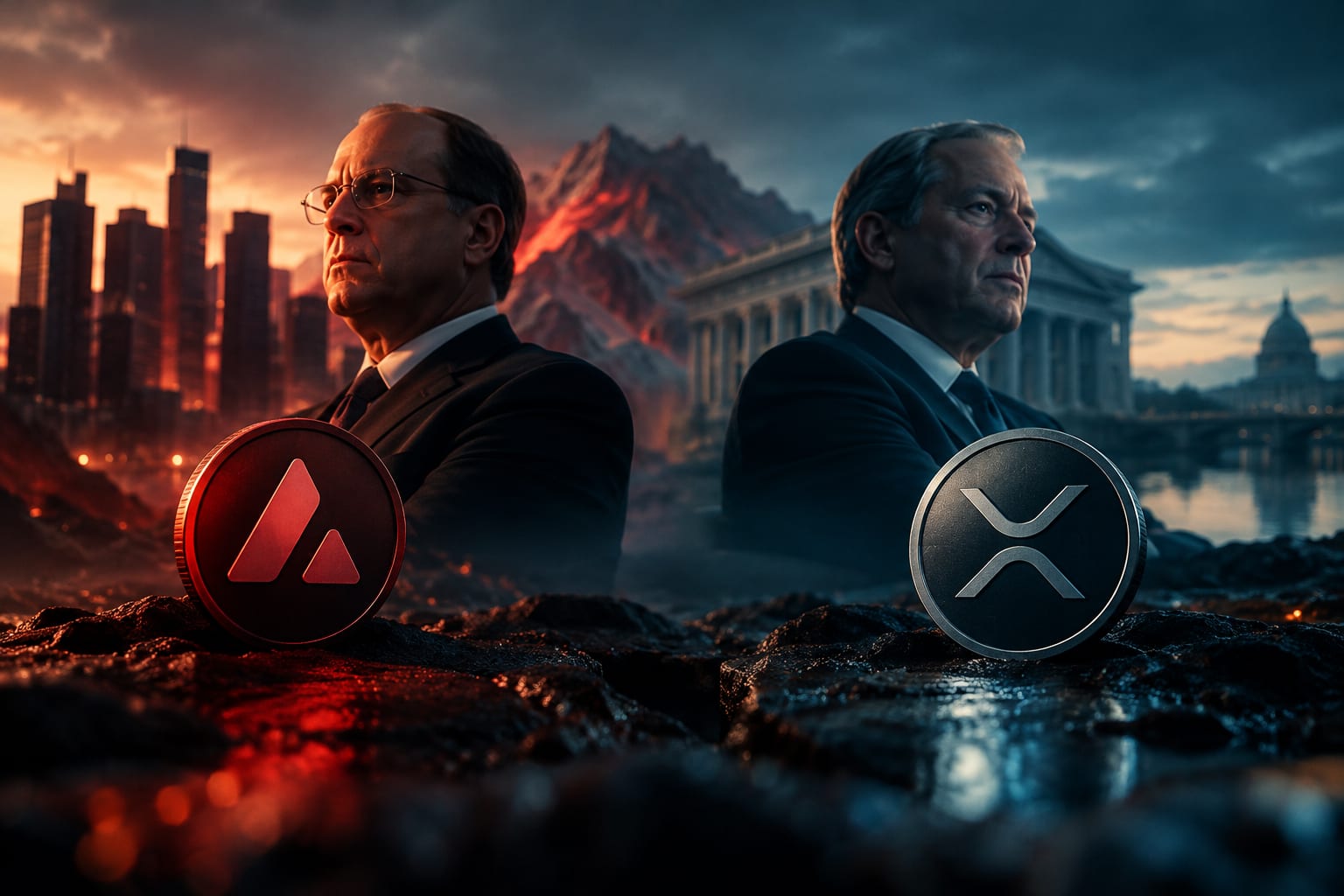
BlackRock added its tokenized dollar liquidity fund to the Avalanche network in November 2024. Nearly a year later, on September 18, 2025, Franklin Templeton announced a separate move, partnering with Singapore's DBS Bank and Ripple to issue its tokenized money market fund on the XRP Ledger. Both announcements involved two of the largest asset managers in the world choosing a blockchain for regulated financial products, and both were treated as milestones for the crypto networks involved.
As of October 10, 2026, neither AVAX nor XRP has benefited in price terms. AVAX trades at $10.55, about 93% below its peak of $144.96. XRP sits at $1.41, roughly 61% off its all-time high of $3.65. Over the past week alone, AVAX dipped 3.5% and XRP fell 5.2%, even as tokenization activity on both networks continued to grow.
What the two funds actually put on-chain
Tokenization means creating a digital claim on an asset, such as a share in a fund, using blockchain technology, which can speed up settlement and reduce reliance on brokers and transfer agents. Both the BlackRock and Franklin Templeton products invest mainly in short-term government debt and pass along yields tied to current interest rates.
BlackRock's fund launched on Ethereum in March 2024 and expanded to Avalanche that November, managed by tokenization firm Securitize. Across all the chains it operates on, the fund has accumulated about $2.2 billion, while Avalanche's total tokenized real-world assets from all issuers have passed $2.1 billion.

Franklin Templeton's fund, which held more than $736 million at the time of its announcement, trades on DBS's digital exchange using RLUSD, Ripple's dollar-backed stablecoin. Later phases could let clients use fund tokens as loan collateral, though those plans remain in the exploratory stage. The XRP Ledger has also taken in $2.2 billion in tokenized commodities in 2026, more than Ethereum's $1.6 billion over the same period.
Why the partnerships haven't moved AVAX or XRP prices
The only direct link between these funds and the underlying coins is transaction fees. Avalanche users pay fees in AVAX, and XRP Ledger users pay small fees in XRP, with both networks burning those fees so they leave circulation. But fees only arise when fund tokens are issued, transferred or redeemed. Investors who hold cash-like funds for yield tend not to trade them often, so token movement, and the fees it generates, stays minimal.
Given AVAX's market value of around $4.7 billion and XRP's $88.7 billion, that trickle of fee activity is far too small to meaningfully affect either coin's price. On top of that, the mechanics of each deal keep the cryptocurrencies at arm's length. On DBS's exchange, clients swap RLUSD for Franklin Templeton's fund tokens, and the announcement did not name XRP as the asset used to facilitate those trades. BlackRock's fund likewise made no specific commitment to AVAX beyond paying network fees.
Who this affects
This story matters most to people who already hold AVAX or XRP, or who are watching crypto markets because of headlines about major financial firms embracing blockchain. It's a reminder that an institution choosing a network for a regulated fund is not the same as that institution buying or endorsing the network's native coin. Households following these partnerships for signals about future price movement may be reading more into the news than the underlying mechanics support.
Which network has the edge, and why it may still not matter to coin holders
The XRP Ledger currently holds a modest advantage. Its arrangement links a fund manager, a regulated bank exchange, and a stablecoin, with a possible collateral phase still to come. If DBS does roll out collateral use and names XRP specifically as a settlement or collateral asset, that could create more regular demand for the token. If the collateral phase proceeds using only RLUSD, the XRP Ledger may still be favored by Wall Street without that translating into real demand for XRP itself.
Avalanche's position is different since BlackRock's fund runs across multiple chains, making Avalanche one option among several rather than an exclusive home. Franklin Templeton's XRP holders do get one more direct link, a spot XRP ETF the firm launched in November 2025 that buys and holds XRP directly, something Avalanche lacks in this comparison.
Readers trying to make sense of how institutional blockchain activity connects, or doesn't connect, to coin prices may find it helpful to see these developments explained plainly rather than treated as a promise of future gains. As always with evolving financial products and digital assets, anyone considering how this news applies to their own holdings or plans should check their specific situation with a licensed financial professional.
Tokenized funds like BlackRock’s BUIDL and Franklin’s BENJI show how institutions are testing blockchain for assets once held mainly as gold reserves.
Source: 24/7 Wall St.
If you missed it: Ethereum ETFs Shed Nearly $2 Billion Over Nine Days, But Falling Prices Explain Most of the Drop