
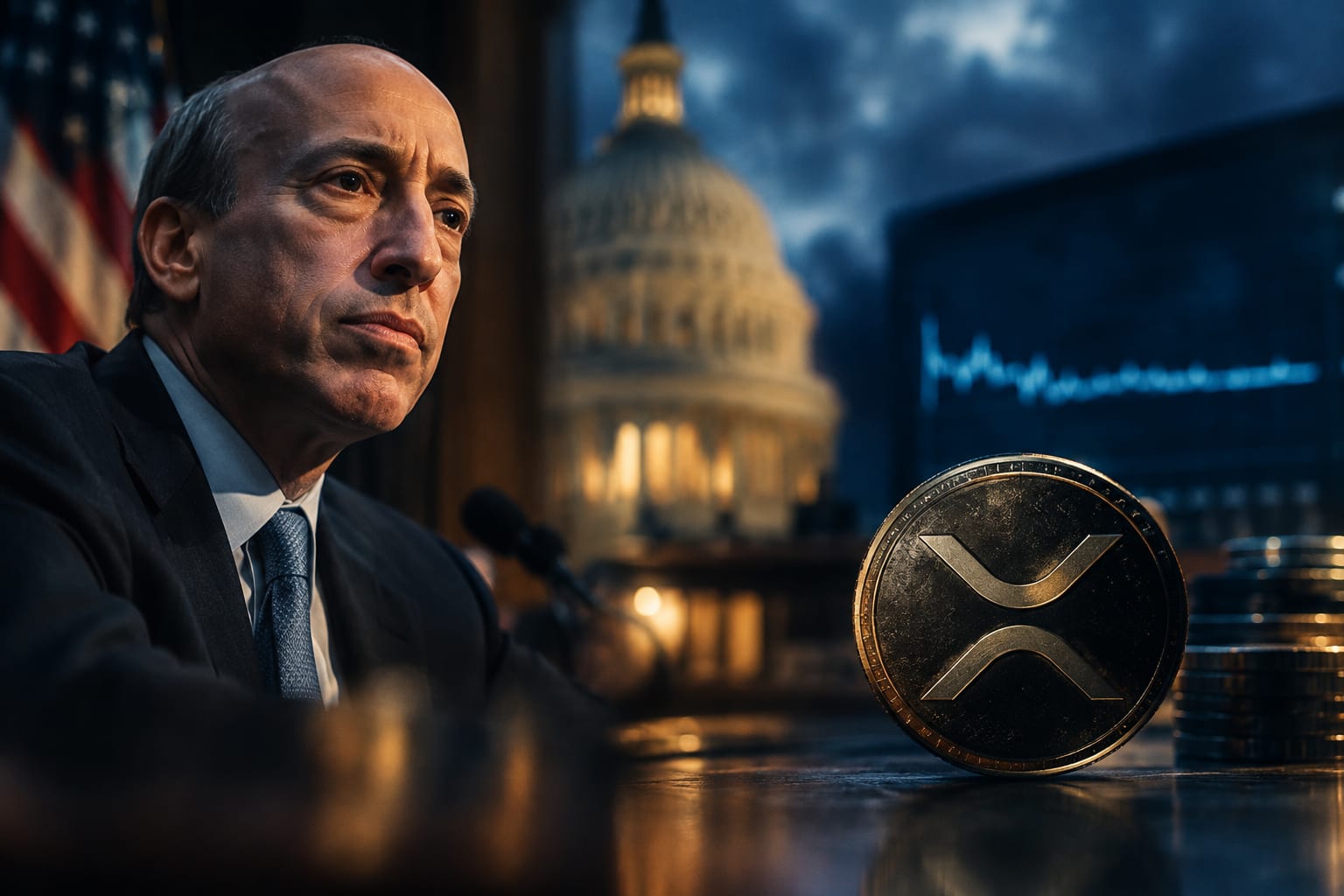
SEC Chair Says Most Crypto Isn’t a Security, But XRP Still Hasn’t Moved
SEC Chair Paul Atkins told an audience at the Economic Club of Dallas that "most crypto assets are not themselves securities," pointing to the agency's proposed Regulation Crypto Assets and a planned Innovation Exemption for trading tokenized securities onchain. The remarks came four days after Ripple announced that the Office of the Comptroller of the Currency gave final approval to charter Ripple National Trust Bank. Despite both pieces of news, XRP traded at $1.25, up 1.12% over 24 hours, but still down 16.08% for October 2026 and 65.75% below its July 2025 record of $3.65.
For households trying to follow crypto headlines without getting lost in jargon, it helps to separate what a regulator says from what a court has already decided. That is the gap at the center of this story, and it is worth walking through carefully.
What Atkins proposed and what courts already decided
The SEC's proposed Regulation Crypto Assets, put forward on August 18, 2026, would create a rulebook for raising money through tokens. It would exempt startups raising up to $5 million over four years, or up to $75 million in a single year, from full SEC registration. The proposal remains open for public comment for 60 days after publication in the Federal Register, meaning it is not yet law. It also includes a safe harbor meant to protect a token once it stops being classified as an investment contract, the legal test for whether a buyer is handing over money expecting profit from someone else's work.
XRP already went through that test in court. The SEC sued Ripple in December 2020, and on July 13, 2023, Judge Analisa Torres ruled that XRP as a token is not an investment contract, though Ripple's institutional sales broke the law as unregistered offerings while its exchange sales did not. Torres later rejected a joint request from the SEC and Ripple on June 26, 2025, to lift the injunction and reduce Ripple's $125 million penalty. Both sides withdrew their appeals on August 7, 2025, closing the case. Because the new proposal targets fresh fundraising, and a court already found XRP's exchange trading was not a securities offering, XRP mostly sits outside what the proposal would change.

Ripple's bank charter leans on its stablecoin, not XRP
Ripple today reports holding more than 85 licenses, serving over 1,700 institutions, and expects roughly $900 million in revenue by the end of 2026, though it has not said how much of that ties back to XRP itself. Its revenue comes from cross-border payments, custody, its stablecoin Ripple USD, a prime brokerage arm called Ripple Prime, and cash-management software through Ripple Treasury.
The new Ripple National Trust Bank will manage RLUSD's segregated reserves, serve as collateral trustee for RLUSD holders, and offer digital-asset custody. No opening date has been given, and Standard Custody & Trust Company continues issuing RLUSD for now. RLUSD carries a market valuation over $2.43 billion and a Moody's A2 rating.
Competition is active elsewhere too. Circle reported $668 million in reserve income for the second quarter of 2026, even as its reserve return rate fell 66 basis points to 3.5%, and won final OCC charter approval in July 2026 with USDC circulation at $73.3 billion. Robinhood plans to settle in RLUSD on the XRP Ledger, and BNY is adding both XRP and RLUSD to its custody lineup, though custody simply stores coins clients already hold rather than driving new purchases.
Who this affects
This story mainly concerns people who already hold XRP, invest in crypto funds, or follow Ripple's business as shareholders or customers of its payment and custody services. It also touches anyone weighing exposure to stablecoins like RLUSD or USDC through banks or brokerages now entering the space. It does not change tax rules, retirement accounts or everyday banking products for the general public.
Even on October 30, 2026, the day Atkins spoke, XRP spot ETFs recorded a net outflow, and the token remains down 50.17% over the past year. Analysts note that if XRP cannot close above its 200-day moving average of $1.28 once any final rule arrives, that would suggest regulatory comfort alone isn't translating into demand.
As with any fast-moving financial news, the practical next step is the same one a careful personal finance writer would recommend to any household: review your own holdings and goals, and talk with a licensed financial professional before making decisions based on headlines alone.
Beyond the regulatory debate, investors are increasingly weighing how well each token’s underlying blockchain technology supports real-world use cases and network growth.
Unlike bitcoin, which is often compared to digital gold, XRP has no direct link to central bank gold reserves or any other hard-asset backing.
Source: 24/7 Wall St.
If you missed it: India's Gold Imports Fall 81%, and What It Could Mean for Prices Worldwide